
From EVs to AI Factories: Why NVIDIA Is Moving Toward 800V DC
The Automotive Industry Has Already Been Through This Transition
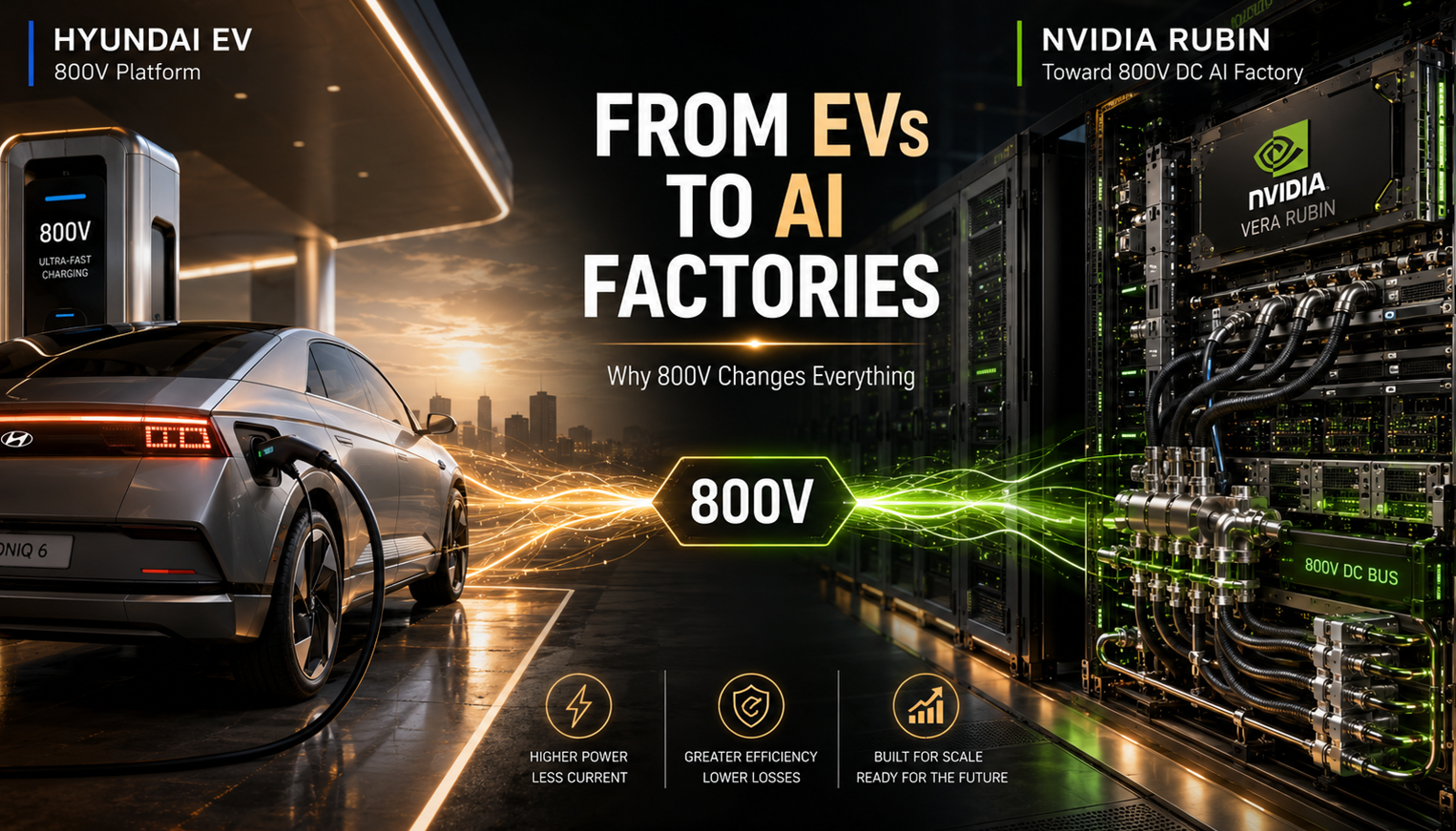
One of the easiest ways to understand NVIDIA's move toward 800V DC AI infrastructure is to look at an industry that has already gone through a remarkably similar transition: electric vehicles.
Early mass-market EVs were largely built around approximately 400V battery architectures.
As vehicle power increased and charging speeds became faster, some leading EV platforms began moving toward 800V electrical systems.
The reason is fundamental physics.
Power = Voltage × Current
For the same amount of power, increasing voltage reduces the required current.
Lower current can reduce cable size, copper requirements, electrical losses and heat generation.
EVs began moving toward 800V because they needed to move more power more efficiently.
AI data centers are now approaching a similar engineering challenge.
AI Data Centers Are Approaching Their Own 800V Moment
Modern AI racks consume dramatically more power than traditional server racks.
Blackwell-generation systems have already pushed rack power well beyond conventional enterprise data center levels.
With Vera Rubin and future generations, the industry is moving toward rack densities above 200 kW and, over time, potentially toward 500 kW and 1 MW-class AI racks.
The problem is current.
At low voltage, moving enormous amounts of power requires enormous current.
Using a simple theoretical comparison for 1 MW:
At 54V: approximately 18,500 amps
At 800V: approximately 1,250 amps
Real data center power systems contain multiple conversion and distribution stages, so this is not a literal rack design calculation.
But it clearly illustrates why voltage becomes increasingly important as AI power density rises.
Why 800V DC?
As AI factories move toward hundreds of kilowatts and eventually megawatt-class rack power, simply adding more conventional power shelves becomes increasingly difficult.
Higher current means:
- Larger busbars
- Thicker cables
- More copper
- Larger connectors
- Higher electrical losses
- More heat
- Less rack space available for compute
800V DC allows much more electrical power to be distributed at substantially lower current.
A future AI factory power path can conceptually look like:
Grid → Facility Power Conversion → 800V DC → AI Rack → DC/DC Conversion → GPU
The move to 800V is therefore not simply a voltage change.
It represents a redesign of the AI factory power architecture.
Does 800V Begin With Vera Rubin?
An important distinction is required.
The arrival of Vera Rubin does not mean that every Rubin rack immediately becomes a native 800V DC rack.
Vera Rubin is better understood as an important transition generation in which compute, power and cooling become much more tightly integrated.
The Rubin era brings together:
- Rack power moving beyond the 200 kW class
- 100% liquid-cooled rack architecture
- Warm-water cooling around the 45°C range in selected designs
- Advanced rack-scale power management
- A migration path toward next-generation 800V DC infrastructure
DATAAD therefore views Vera Rubin as a bridge generation rather than the final destination of the 800V transition.
The economic and physical advantages of 800V DC are likely to become much stronger as rack power moves toward 500 kW and eventually 1 MW.
EVs and AI Data Centers Are Solving Surprisingly Similar Problems
| Area | Electric Vehicle | AI Data Center |
|---|---|---|
| Previous Architecture | Approx. 400V | 54V-class rack distribution |
| New Direction | 800V EV Platform | 800V DC Distribution |
| Main Driver | Higher power and faster charging | Higher AI compute density |
| High-Current Problem | Heavy cables and thermal losses | Large busbars, copper and power shelves |
| Higher-Voltage Benefit | Lower current | Lower current |
| Thermal Challenge | Battery, inverter and motor cooling | GPU, power electronics and network cooling |
| System Direction | Integrated EV platform | Integrated AI Factory |
And Then Comes Cooling
Higher voltage solves only part of the problem.
The EV industry also had to develop increasingly sophisticated liquid cooling for batteries, inverters, motors and power electronics.
AI infrastructure is following a similar path.
More electrical power delivered to GPUs ultimately means more thermal energy must be removed.
The future AI factory therefore has to manage two flows simultaneously.
Electrical Flow
Grid → 800V DC → Rack → Power Electronics → GPU
Thermal Flow
GPU → Cold Plate → Coolant → Manifold → CDU → Facility Water → Heat Rejection
These two systems will become increasingly difficult to design independently.
The AI Rack Is Becoming an Industrial Machine
A modern EV is no longer simply a battery connected to an electric motor.
It is an integrated system:
Battery + Inverter + Motor + Power Electronics + Liquid Cooling + Control
The future AI rack is moving in the same direction.
It increasingly becomes:
GPU + Networking + Power Electronics + High-Voltage DC + Liquid Cooling + Control
As rack power approaches the megawatt level, the AI rack begins to look less like a traditional IT cabinet and more like a high-power industrial machine.
The 800V Transition Creates a New Component Market
The EV industry's shift toward 800V changed much more than battery voltage.
It created new demand for:
- SiC power semiconductors
- High-voltage DC/DC converters
- High-voltage connectors
- Busbars
- Advanced insulation systems
- Liquid cooling
- Thermal interface technologies
The AI data center industry may now create a similar supply-chain opportunity.
New demand is emerging not only in electrical infrastructure but also in cooling:
- GPU cold plates
- Future two-phase evaporator and boiler plates
- Rack manifolds
- Quick disconnect couplings
- High-flow hoses
- CDUs
- Pumps
- Heat exchangers
- Liquid coolants
- Leak detection and monitoring
ImmerseKool: From EV Liquid Cooling to AI Factory Cooling
The convergence of EV and AI infrastructure also creates an interesting industrial connection.
ImmerseKool has already supplied liquid cooling solutions for EV applications and is now extending that experience toward AI data center cooling.
EV systems require reliable thermal management of batteries and power electronics.
Future AI factories require reliable thermal management of GPUs, networking hardware and increasingly high-power electronic components.
Building on its EV cooling experience, ImmerseKool plans to continue developing and supplying liquid cooling solutions and components for next-generation high-density AI infrastructure, including:
- Liquid coolants
- Cold plates and future two-phase boiler / evaporator plates
- Quick disconnect couplings
- Hose assemblies
- Manifolds and fluid distribution components
- CDU connection components
- Single-phase DLC solutions
- Future two-phase direct-to-chip cooling components
The objective is not to manufacture the 800V electrical architecture itself.
The opportunity is to develop the cooling architecture and components capable of handling the thermal density created by 800V-powered, megawatt-class AI infrastructure.
DATAAD View: AI Is Entering Its Own EV 800V Moment
The EV industry did not move toward 800V because 400V suddenly stopped working.
It moved because higher power, faster charging and improved efficiency made continued scaling of the previous architecture increasingly difficult.
AI data centers are entering a similar period.
54V-class rack power still works today.
But as the industry moves from 100 kW to 200 kW, 500 kW and eventually 1 MW, the physical and economic limits of existing architectures will become increasingly visible.
And when power architecture changes, cooling architecture must evolve with it.
EVs moved toward 800V because moving more power at lower current became essential.
AI factories are now approaching the same conclusion.
That leads naturally to the next question:
Which liquid cooling technology will ultimately cool the 1 MW AI rack?
The answer may depend on how far advanced single-phase DLC can be pushed — and how quickly two-phase direct-to-chip cooling becomes ready for large-scale deployment.